Work plan
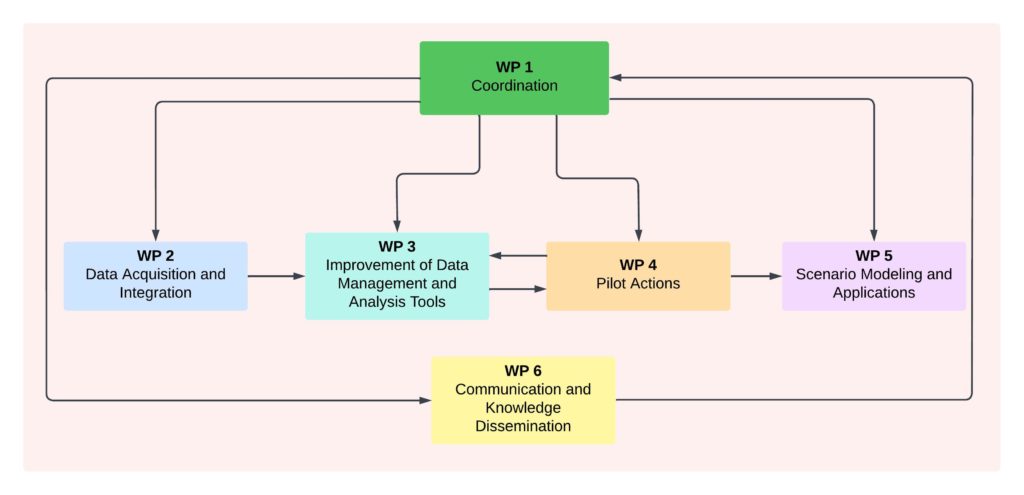
Work Package 1 oversees the overall project management, ensuring that all work packages are aligned, deadlines are met, and resources are efficiently distributed. It provides leadership and guidance across the project.
Work Package 2 focuses on harmonizing and integrating data collection strategies, ensuring that data from various sources is compatible, standardized, and of high quality. This WP makes sure that accurate data is available for further analysis.
Work Package 3 Aims to enhance data management systems and tools, improving data storage, accessibility, and security. It ensures that data is organized effectively and that the overall data quality is maintained.
Work Package 4Â is responsible for conducting pilot projects that test the strategies and tools developed in the previous work packages. These pilots will focus on validating the carbon sequestration models, testing new technologies in real-world environments, and gathering feedback for further improvements. It also aims to demonstrate the practical applicability of the developed systems in various contexts.
WP 5 works on developing and applying scenario models that simulate different carbon sequestration strategies under various environmental conditions. This WP helps in understanding the impact of different variables on the carbon sequestration process and informs decision-making for policymakers and stakeholders. It will provide forecasts and actionable insights for the long-term sustainability of the ecosystems being studied.
WP 6 focuses on the communication strategy of the project, ensuring that results are effectively shared with stakeholders, the scientific community, and the general public. This WP will handle the dissemination of findings through reports, conferences, publications, and outreach activities. It also includes managing the project’s website and social media to ensure public engagement.
Publications
Wetlands4Climate
Networking eng TROPHYC
TROPHYC is a project financed by the Italian Ministry of University and Research – MUR
Products TROPHYC
Check back this page to find all the project deliverables.
TROPHYC is a project financed by the Italian Ministry of University and Research – MUR
News TROPHYC
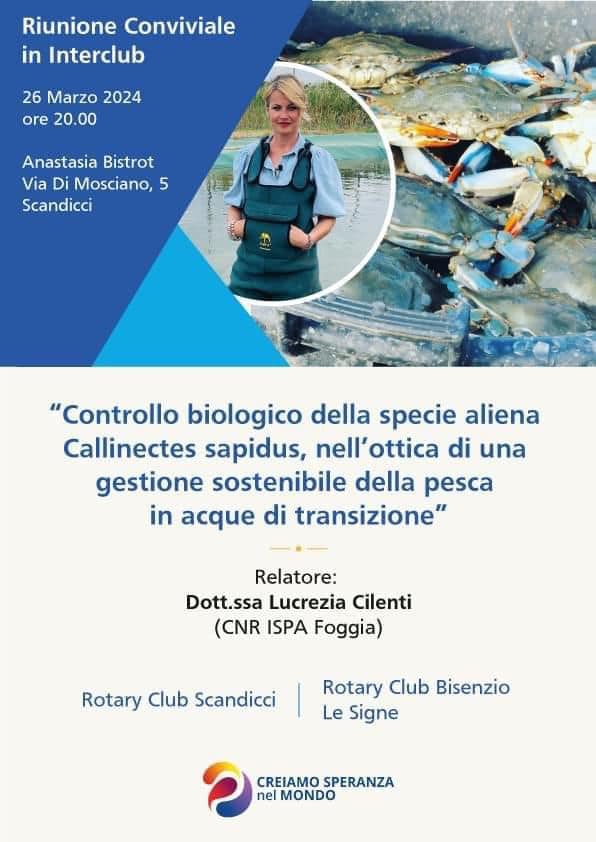
Cilenti L. (2024). Controllo biologico della specie aliena Callinectes sapidus, nell’ottica di una gestione sostenibile della pesca in acque di transizione. Public outreach seminar, event organised by the Rotary Club Scandicci and Rotary Club Bisenzio Le Signe.
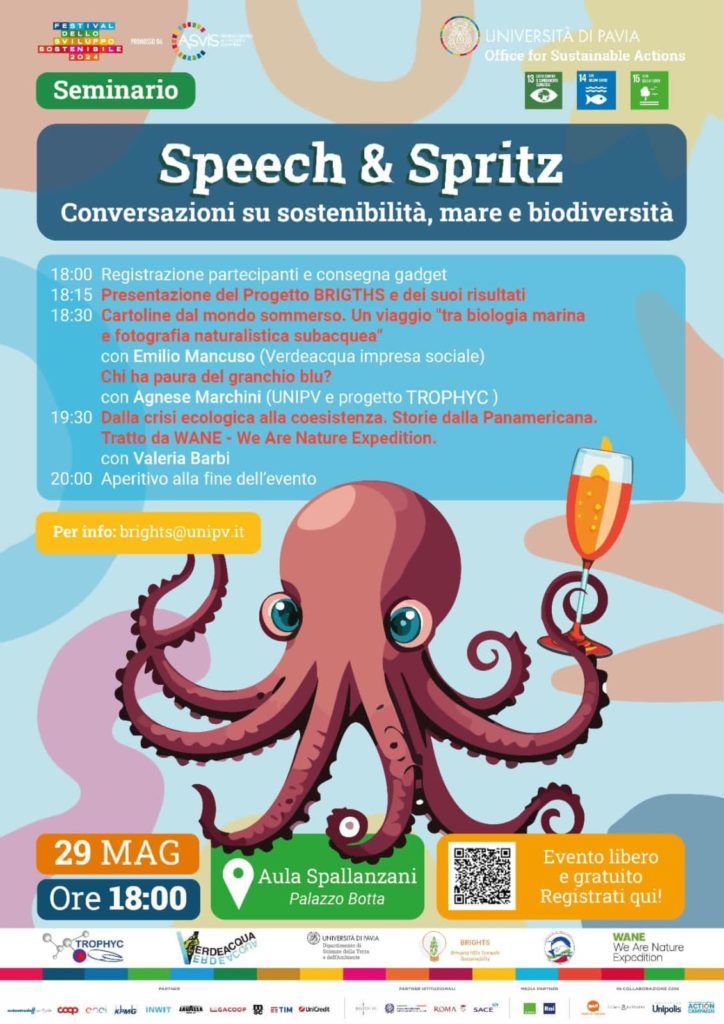
Marchini A. (2024). Chi ha paura del granchio blu? (progetto TROPHYC). Public outreach seminar “Speech & Spritz – Conversazioni su sostenibilitĂ , mare e biodiversità ” organised by Office for Sustainable Actions, 29/05/2024
Other relevant news:
29/11/2023_article on “UNIPV.news”
02/12/2023_article on “Corriere Salentino”:
02/12/2023_article on “LecceSette”
02/12/2023_article on “Stato Quotidiano”
02/12/2023_article on “Quotidiano di Puglia”
02/12/2023_article on “PugliaIn.net”
02/12/2023_article on “La Voce a Sud”
02/12/2023_article on “Giornale di Puglia”
02/12/2023_article on “PugliaLive”
02/12/2023_article on “NewsIMedia”
02/12/2023_press review on “Agenparl”
05/12/2023, interview on the TROPHYC project on the Antenna Sud channel (also available on the YouTube channel; UNISALENTO participates with Prof. Giorgio Mancinelli).
https://www.youtube.com/watch?v=klwLRmpwF14
14/12/2023_article on “FoggiaToday”
14/12/2023_article on “PalermoToday”
26/12/2023_article on “Il Mattino di Foggia”
18/07/2024_article on “Il Millimetro”
TROPHYC is a project financed by the Italian Ministry of University and Research – MUR
Products-USEit
- Data Management Plan – The DMP defines the common and coordinated strategy adopted in the USEit project for the management of research products on invasive alien species following the principles of FAIR (Findable, Accessible, Interoperable and Reusable) and Open Science. The DMP takes into account all phases of the data lifecycle to ensure that the data collected and generated during the project activities are quality controlled, documented, archived and preserved for the long term, interoperable and made accessible for reuse in other projects or research activities.
- Synthesis from a national survey – This document stems from the responses to a national survey about the research activities focusing on the collection of data on Non-Indigenous Species (NIS) and provides an initial base for assessing the type and quantity of this information. The aim of this document is to stimulate reflections and concrete proposals to improve research processes on NIS in the light of current scientific knowledge, and to identify gaps and criticalities in data collection processes in order to improve the management of biological invasions in Italy, in both aquatic and terrestrial environments.
- USEit Data Portal: unique access point to dataset produced and/or published within the project [Portal]
- Aalto: Sample training set for Ailanthus altissima visual aid reconnaissance [Dataset]
- Alvar: Ailanthus altissima visual aid for reconnaissance [Service]
- Citizen science records of the invasive brown marmorated stink bug Halyomorpha halys in Sardinia [Dataset]
- Distribution and abundance of Anadara spp. in the Northern Adriatic Sea from 2008 to 2023 [Dataset]
- Elemental composition of non-indigenous marine species of potential commercial interest [Dataset]
- ORMEF: Occurrence Records of Mediterranean Exotic Fishes [Dataset]
- Stable isotopes of marine invasive alien species in Mediterranean waters [Dataset]
- Stable isotopes of soil and leaf samples in sites invaded by Ailanthus altissima [Dataset]
USEit is a project funded by the National Research Council of Italy
USEit è un progetto finanziato dal Consiglio Nazionale delle Ricerche
Events TROPHYC
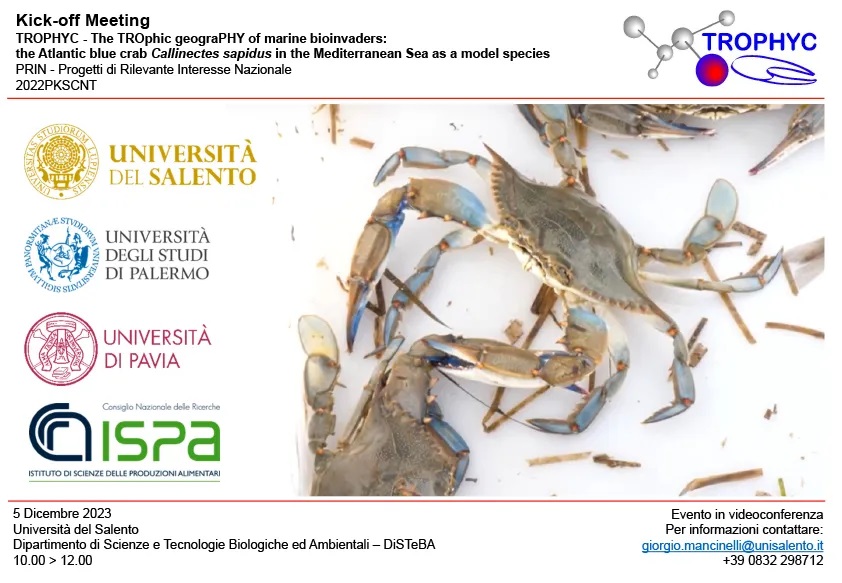
Kick-off meeting of the PRIN TROPHYC project partners hosted by the University of Salento – Dipartimento di Scienze e Tecnologie Biologiche ed Ambientali – DiSTeBA, Lecce. Illustrated the objectives and aims of the project. Shared with supporting partners the protocols to be adopted in order to have a coherent and homogeneous data set at pan-mediterranean level. Participation of all partners, 05 Dec 2023.
TROPHYC is a project financed by the Italian Ministry of University and Research – MUR
Work plan TROPHYC
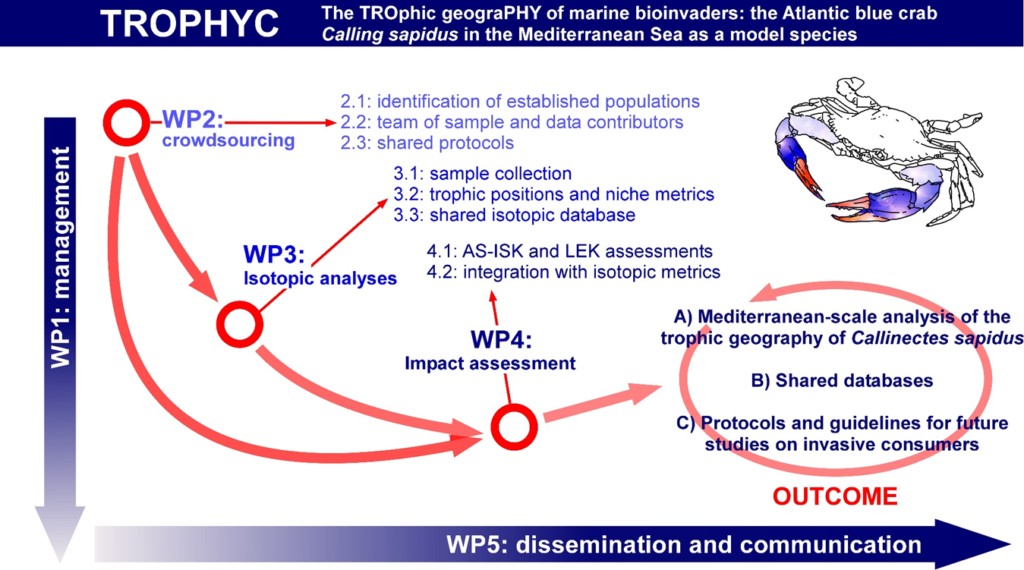
The work plan proposes a multidisciplinary, crowdsourcing approach aimed at large-scale data collection on the trophic position and ecological impact of Atlantic blue crab (Callinectes sapidus) in different regions of the Mediterranean Sea. This will provide an advanced understanding of the trophic impact of the species and develop a more effective management of the impact of invasive alien species (IAS) to support the protection of the biodiversity and integrity of coastal ecosystems.
The work plan, carried out by experts in marine ecology and stable isotopes analysis, will be divided into five different Work Packages, described below.
WP1 – Project management – WP leader Unisalento
Work Package 1 is dedicated to the coordination and management of the project. Specifically, managing administrative aspects, monitoring activities, writing reports, and organizing meetings/workshops with all partners to define procedures, monitor progress, and ensure that project objectives are met.
WP2 – Inventory of blue crab populations and involvement of data providers – WP leader Unisalento
This Work Package will have as its main objective to assess the state of art of the presence of established Atlantic blue crab populations in the Mediterranean Sea, then identify project study areas and assemble a large group consisting of scientists, academics and governmental organizations (data providers – DPs). Activities within WP2 will include in detail the drafting of methodological guidelines for sample collection and pretreatment of them, the development of questionnaires to be provided to DPs to obtain quantitative assessments of the trophic impact of blue crab in the study areas and the organization of an informational meeting with DPs to discuss the protocols and methodologies to be followed.
WP3 – Stable isotope analysis – WP leader UNIPA
Work Package 3 is devoted to stable isotope analysis to estimate the diet and trophic position of Atlantic blue crab in different study areas in the Mediterranean Sea. WP3 activities include collection of blue crab and baseline bivalves samples from DPs, stable isotope analysis of carbon (δ13C) and nitrogen (δ15N) to estimate the trophic position and isotopic niche of blue crab populations, in-depth analyses of the trophic preferences of blue crab in the study areas in Italy (Stagnone di Marsala and Lesina Lagoon) by collecting samples of potential plant and animal prey, and finally, the processing and analysis of collected data.
WP4 – AS-ISK, LEK, and data integration – WP leader UNIPV
The fourth Work Package will focus on collecting blue crab impact data by means of specific questionnaires submitted to DPs, the results of which will then be integrated with isotopic analyses. The three main activities planned are: the collection of AS-ISK and LEK questionnaires by the partners, analysis and summaries of the collected data by using spatial statistical methods similar to those used for SIAs, and integration of the data obtained from the questionnaires with those obtained by stable isotope analysis.
WP5 – Dissemination and outreach – WP leader CNR
Work Package 5 will focus on the dissemination of TROPHYC project results to various levels: the scientific community, the public, stakeholders, regional entities and international organizations. Planned activities include the production of scientific publications, press releases, involvement of entities and networks to maximize the dissemination of results and their impact on decision-making processes.
TROPHYC is a project financed by the Italian Ministry of University and Research – MUR